1
Richard Misrach’s Golden Gate dreams
By Lauren Gallagher
When photographer Richard Misrach and his wife moved in to their Berkeley hills home in 1997, they stumbled on something that became an iconic project for Misrach.
“We didn’t know about the view when we bought the house,” says Misrach, who appears in a City Arts & Lectures presentation Monday at Herbst Theatre.
The home, where they still live, was engulfed in vegetation. After a week’s manicuring, Misrach and his wife saw the full span of the Golden Gate Bridge, Alcatraz and San Francisco’s sparkling skyline.
“Once I saw the view, I knew I had a project,” Misrach says.
For the next four years, Misrach photographed the bridge from his front porch, for the series “Golden Gate.” The images, published in the book “Richard Misrach: Golden Gate” in 2001, are featured again in a sumptuous, new large-format edition published by Aperture slated for a June release.
“A phenomenal spectacle of light, color and weather comes through the Golden Gate,” Misrach says. “It changes on an hourly, sometimes minute-by-minute basis.”
Fixing his camera in the same spot, Misrach used the same lens, and cropped the same section of the bridge for each photo, allowing the Bay’s atmospheric drama to take center stage. His prints, sometimes as large as 8-by-10 feet, are mesmerizing, and sometimes dwarf the viewer.
A Bay Area resident since 1967, Misrach investigates man’s intersection with nature in his large-format landscape photographs. He has been inspired by Ansel Adams, Edward Weston and other influential Western photographers in Group f/64, but his work moves beyond the pastoral.
He has photographed mass livestock graves in the Nevada desert, a petrochemical wasteland along Louisiana’s Mississippi River known as “Cancer Alley,” the 1991 Oakland-Berkeley fire and Hurricane Katrina.
“I use the Western landscape as a microcosm,” Misrach says. “The man-made fires, floods, natural fires, dead animal pits and things like that are a microcosm for what’s going on across the rest of the planet. I try to document a historical moment, and I think years from now they may speak to climate change issues, oil use and so on.”
Clearly sensitive to time, and out of respect to his subjects, Misrach waited 20 years to show most of his Oakland-Berkeley fire photos, and his “Cancer Alley” series is being revisited by the High Museum of Art in Atlanta this summer, nearly 15 years after he began it.
He also waited several years before releasing images from “Destroy This Memory,” his documentation of graffiti messages scrawled in Katrina’s wake.
“Many of these situations are delicate,” Misrach says. “But it seems important to me to have recorded as much, as thoroughly and as well as possible. I strive for a level of formal beauty that makes them function more like history paintings. They are about a historical moment.”
“We didn’t know about the view when we bought the house,” says Misrach, who appears in a City Arts & Lectures presentation Monday at Herbst Theatre.
The home, where they still live, was engulfed in vegetation. After a week’s manicuring, Misrach and his wife saw the full span of the Golden Gate Bridge, Alcatraz and San Francisco’s sparkling skyline.
“Once I saw the view, I knew I had a project,” Misrach says.
For the next four years, Misrach photographed the bridge from his front porch, for the series “Golden Gate.” The images, published in the book “Richard Misrach: Golden Gate” in 2001, are featured again in a sumptuous, new large-format edition published by Aperture slated for a June release.
“A phenomenal spectacle of light, color and weather comes through the Golden Gate,” Misrach says. “It changes on an hourly, sometimes minute-by-minute basis.”
Fixing his camera in the same spot, Misrach used the same lens, and cropped the same section of the bridge for each photo, allowing the Bay’s atmospheric drama to take center stage. His prints, sometimes as large as 8-by-10 feet, are mesmerizing, and sometimes dwarf the viewer.
A Bay Area resident since 1967, Misrach investigates man’s intersection with nature in his large-format landscape photographs. He has been inspired by Ansel Adams, Edward Weston and other influential Western photographers in Group f/64, but his work moves beyond the pastoral.
He has photographed mass livestock graves in the Nevada desert, a petrochemical wasteland along Louisiana’s Mississippi River known as “Cancer Alley,” the 1991 Oakland-Berkeley fire and Hurricane Katrina.
“I use the Western landscape as a microcosm,” Misrach says. “The man-made fires, floods, natural fires, dead animal pits and things like that are a microcosm for what’s going on across the rest of the planet. I try to document a historical moment, and I think years from now they may speak to climate change issues, oil use and so on.”
Clearly sensitive to time, and out of respect to his subjects, Misrach waited 20 years to show most of his Oakland-Berkeley fire photos, and his “Cancer Alley” series is being revisited by the High Museum of Art in Atlanta this summer, nearly 15 years after he began it.
He also waited several years before releasing images from “Destroy This Memory,” his documentation of graffiti messages scrawled in Katrina’s wake.
“Many of these situations are delicate,” Misrach says. “But it seems important to me to have recorded as much, as thoroughly and as well as possible. I strive for a level of formal beauty that makes them function more like history paintings. They are about a historical moment.”
from: http://www.sfexaminer.com/sanfrancisco/richard-misrachs-golden-gate-dreams/Content?oid=2199567
2
It sounds as if Richard Misrach always had a camera in his hand. At the age of twelve his parents put him in charge of photographing the family vacations…but he was never serious about it. Then in high school he took a photography course and did well…but he wasn’t really serious about it. In college at Berkley in the late 1960s Misrach studied math and psychology; he kept a 35mm camera on hand to photograph the student protests and riots…but it was just to document; he wasn’t actually serious about it. In 1969, between demonstrations and classes, Misrach went to see an on-campus exhibition of the photographs of Roger Minick. “I recognized the beauty and the power of the medium,” he said, after seeing Minick’s work, “and felt for the first time that it was something I should be doing with my life.” And he got serious.
How serious? He bought a Hasselblad.
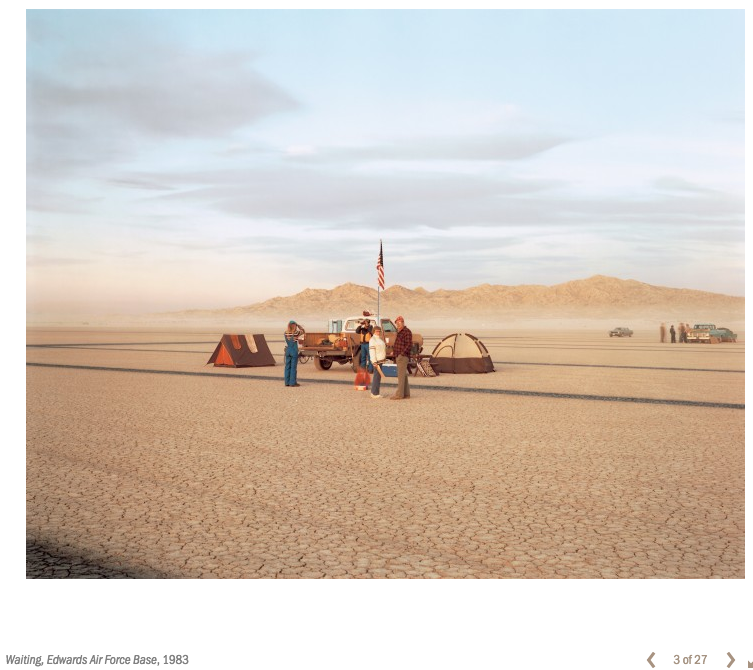
As a child of the 60s, it’s not surprising that Misrach’s first major project was to document Berkley’s homeless population. That’s perfectly in keeping with his interest in photographing the student demonstrations of the period. Although he never lost his interest in social issues, Misrach felt increasingly drawn to photography as a means of making art. His greatest interest (and the one we’re exploring here) was in the art of the landscape.

Battleground Point #20, 1999
During those early family vacations, Misrach was exposed to the desert. The nature of the desert…any desert…tends to distill the world to its simplest components: light and a horizon line. Once he became serious about photography, it was not surprising that he would return to the desert. His fascination with the desert turned into a life-long project, which he calls theDesert Cantos. The project, patterned after the Cantos of Ezra Pound, takes the form of a long, epic visual poem.
One stanza of that poem involves Battleground Point, an area in the northern Nevada desert that lies between the Carson and Humboldt Rivers. Every decade or so heavy winter storms cause those rivers to flood, temporarily turning Battleground Point into an eerie union of desert and wetlands. For Misrach, that was an opportunity not to be missed.
Of the desert, Misrach has said, “Once you fall in love with it that’s it. The light, the space, the solitude, the silence. Oh my god. It’s a really powerful place to be. You’re with yourself.”
But Misrach’s landscape work extends beyond the parameters of traditional landscape photography. Like Edward Burtynsky, Misrach likes to blend social concerns and documentary awareness into the art of the landscape. Critics and curators have referred to his photography as cultural landscapes. He creates large panoramas depicting the interactions of humanity with the landscape. But where Burtynsky explores the damage done by human interactions with the land, Misrach’s work is more general. He’s not taking aim at the damage…intentional or accidental…done to the planet by humankind; he’s simply examining the footprint we leave behind on the physical world.

Submerged Lamppost, Salton Sea, 1985
There is something in the essential quality of humanity that seems uncomfortable with the notion of emptiness. Writers need to fill the blank page and painters need to fill the blank canvas. Even though we may admire the spare beauty of the desert, the very emptiness and sheer flatness of it seems to induce in us a need to fill it. Unlike writers and painters, however, humankind isn’t always very discriminating about what we fill deserts with. We may install a few artful and awe-inspiring pyramids, but we’re just as likely…more likely, in fact…to fill that empty space with drive-in movie screens or concrete bunkers packed with industrial and nuclear waste.
Says Misrach, “The human struggle, the successes and failures, the use and abuse, both noble and foolish, are readily apparent in the desert. Symbols and relationships seem to arise that stand for the human condition itself. It is a simple, if almost incomprehensible equation: the world is as terrible as it is beautiful, but when you look more closely, it is as beautiful as it is terrible.”

White Man Contemplating Pyramids, 1989
One of the things that distinguishes Misrach’s desert images is an indefinable sense that the beauty of the desert will prevail. The artifacts humans build in the world’s deserts…the movies screens, the pyramids…may clutter up the landscape, but they cannot mar the splendor of the desert. At least not for very long. In desert terms, five thousand years isn’t very long.
As his interest in art grew, so did the size of Misrach’s cameras. Eventually he began to use the camera of choice for most landscape photographers: an 8×10 view camera. He worked very simply: one camera, one lens, one type of color negative film. With the larger camera came larger negatives and, of course, larger prints…four feet by five feet. It takes a large print to convey some sense of the magnitude of the desert, some sense of its emptiness, some sense of the landscape’s power and authority.

Drive-in Theater, Las Vegas, 1987
I have spent my half century on the planet primarily in the eastern half of the United States…the forests of New Hampshire, the coasts of Maine and South Carolina, the tidewaters of southern Virginia, the green fields of Iowa and Ohio. I have visited the deserts of the American Southwest and found them to be alien and astonishing. The desert landscape reminded me every day…and even more so every night…that we exist on a planet twirling in the vast expanse of space.
The desert made me feel small and inconsequential. It was not a comfortable feeling. And yet I found myself half in love with it all. The quality of light feels both very old and altogether new…as if it’s been hanging around since the beginning of the world just so you could see it for the first time. When I look at the photographs in Richard Misrach’s Desert Cantos I feel them as much in the lower part of my gut as I appreciate them for their beauty.
Ezra Pound, in his Cantos asks:
What thou lov’st well shall not be reft from thee
What thou lov’st well is thy true heritage
Whose world, or mine or theirs
or is it of none?
What thou lov’st well is thy true heritage
Whose world, or mine or theirs
or is it of none?
Richard Misrach, I suspect, would answer that it is mine and yours and his and all of ours.
From: http://www.utata.org/sundaysalon/richard-misrach/
3
RICHARD MISRACH
BATTLEGROUND POINT
MARCH 7 — APRIL 27, 2002
PRESS RELEASE IMAGES

Battleground Point is part of Richard Misrach's Desert Cantos series; this installment documents the rare presence of water in the Nevada desert. Every decade or so, heavy winter storms batter the desert of northern Nevada, filling the Carson and Humboldt Rivers beyond capacity and flooding the Carson Sink. As high waters receded from the sink in the mid-1980s, hundreds of graves slowly emerged from the mud. Archaeologists accounted for 416 individuals who lived in the area over the course of 3,000 years, some of whom may be the genetic ancestors of today's Toidikadi (also called the Stillwater Paiute). According to oral history, the Toidikadi once were at war with a tribe of red-headed giants about whom little else is known. Of the legendary battle, won by the Toidikadi, only the site and its name remain today: Battleground Point. In 1998, torrential rains again flooded the Carson Sink. These photographs were made by Richard Misrach that spring for The Nature Conservancy exhibition In Response To Place.
Richard Misrach was born in 1949 in Los Angeles, California. He attended the University of California, Berkeley during the 1960s. He received his first National Endowment for the Arts Fellowship for a series of images documenting street life on Telegraph Avenue in Berkeley. Misrach recalls driving across the Mojave Desert — a seemingly desolate and foreboding place — as a child with his family. Returning to the desert many years later as an artist, he was struck by its beauty. In 1979, Misrach began an ongoing series of photographs entitled Desert Cantos, simultaneously portraying the unique light, terrain, and inhabitants of the desert and addressing the controversial politics of this unique environment. Battleground Point is the twenty-fourth installment in the Desert Cantos series.
The recipient of numerous honors for his work, Misrach has received four National Endowment for the Arts Fellowships as well as the 2002 Kulturpreis from the German Society of Photography; the 2001 Knight Purchase Award from the Akron Museum of Art; the Koret Israel Prize (1992); the Eureka Fellowship from the Fleishhacker Foundation (1991); and the John Simon Guggenheim Memorial Fellowship (1979). His work is included in a wide array of international museum collections, including the Museum of Modern Art, The Metropolitan Museum of Art, and the Whitney Museum of American Art.
From: http://www.robertmann.com/2002-misrach-press/